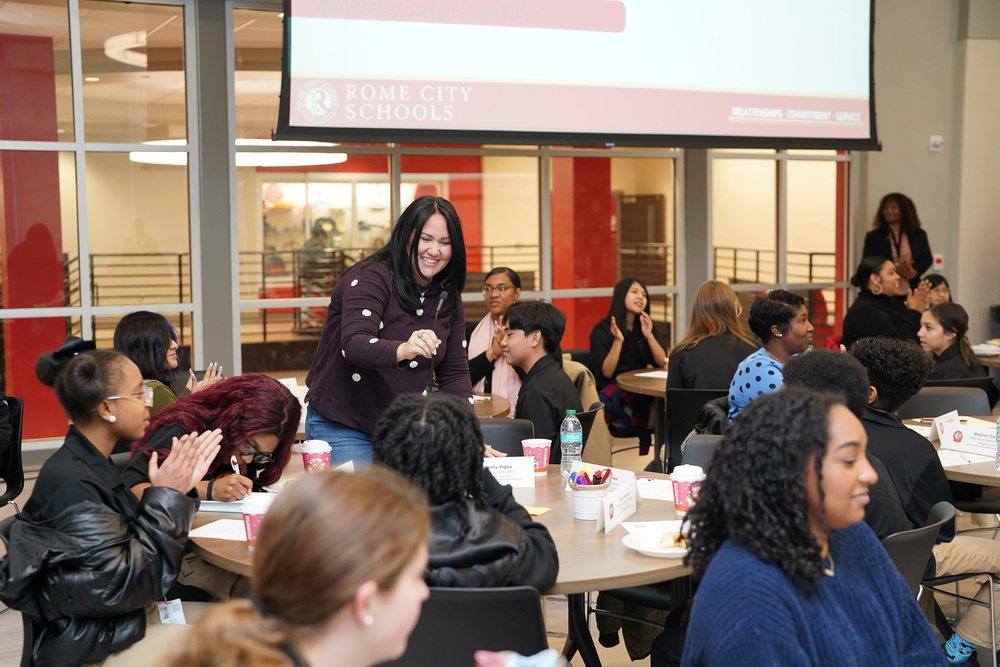
A crowded room at the Rome High School College and Career Academy on Wednesday morning focused on an issue impacting school systems across Georgia - student absenteeism.
The meeting also marked an important collaboration, as members of the Rome High and Rome Middle School Superintendent Student Advisory Council met alongside members of the Rome City Schools Parent Advisory Council. The gathering brought together student and parent perspectives to help address attendance challenges.
“When you turn on the news, you hear a lot of conversation about Senate Bill 123. You hear conversations about kids at homeschool, kids at this school, and kids at that school. For Rome City Schools, the number one indicator tied to school achievement is students coming to school,” Rome City Schools Superintendent Dr. Eric L. Holland said. “The real concern for us is elementary and middle school. The law says that if you are six to 16, you must come to school. When those students are not coming to school, that is a serious issue.”
Senate Bill 123 is a Georgia law aimed at reducing chronic absenteeism by strengthening support for students who miss significant amounts of school.
Under the law, schools and districts with high absenteeism rates must closely examine why students are missing school and develop plans to remove barriers to attendance. Rather than relying on punishment, the law encourages collaboration among schools, families, and staff through attendance review teams to address concerns early and keep students engaged.
“Senate Bill 123 is a new Georgia law that focuses on reducing chronic absenteeism by bringing schools, families, and staff together in a more collaborative way. A student is considered chronically absent if they miss 10 percent of the school year, which equals 18 days, even if those absences are excused with medical or parent notes,” Rome City Schools District Social Worker Kaitlyn Wilson said.
Wilson emphasized the importance of consistent communication between schools and families, particularly when students return from absences with notes. She noted that notes can sometimes get lost in bookbags or backpacks and never reach the school.
“We have a lot of interventions when students begin missing school. Parents need to make sure to communicate with the school when your child is absent,” she said. “We want this to be a collaborative approach so that everyone knows what’s going on.”
The meeting provided an opportunity for the school system to gather input from two of the most important stakeholders in attendance: students and parents.
“The reason we have gathered parents and students together today is that we are hoping that you can brainstorm and come up with some ideas and feedback to help us when it comes to attendance,” John Fricks, Director of Instructional Technology, Safety and Operations, said. “Any feedback is good feedback, even if it’s negative feedback.”
Each table received a large sheet of paper with a question or prompt related to attendance. Students and parents worked together to brainstorm ideas before selecting a spokesperson to share their thoughts with the full group.
Sara Beth Bushnell, a sophomore at Rome High School, shared that frequent absences can cause students to fall behind academically and miss important instructional content.
“You also don’t get to see your friends, and if you miss school, you end up not being able to exempt your exams and maybe even miss out on field trips as well,” she said while presenting her table’s thoughts.
Bushnell also discussed possible reasons students may miss school more often, including heavy workloads, lack of motivation, and mental health challenges. She said these were areas schools could consider addressing.
Rome High School junior Justus Washington spoke about how motivation, or a lack of it, can influence attendance. He also highlighted the importance of parental involvement.
“I think having parents talking to kids about how their day went and asking about what they are doing in school would be a big help because it shows they care and that school is important,” he said.
Rome City Schools staff collected feedback throughout the discussion and reminded students and parents of their role in helping share information with others.
“If we really want to help students and parents, we have to work together. Everything that has been put in place is good, but we have to execute it. When you leave here today as the Student Advisory Council, you have to help us help the student body,” Dr. Holland said. “That means encouraging attendance, creating welcoming spaces, talking with your teachers, talking with your principals, and talking with parents. That is how we make a difference.”